Slator readers are split three ways on the prickly subject of whether AI translation post-editing should be considered translation, with the nays having the majority by a scant margin (No, 36.7%), followed by those on the opposite end (Absolutely, 33.3%), and those who are uncertain (Up for debate, 30.0%).
Officially Postponed
Spain’s bid to elevate Basque, Catalan, and Galician to official languages of the European Union (EU) has been postponed for a second time, following an initial deferral in September 2023.
The Spanish Minister of Foreign Affairs, José Manuel Albares, first requested the country’s co-official languages inclusion in August 2023, while Spain held the EU presidency. At the time, the EU cited a need for more information before deciding whether to put the matter to a vote, and several countries opposed the motion.
The most recent postponement happened in May 2025, after at least ten countries indicated they would reject the proposal if it went to a vote. A unanimous vote from all 27 EU Member States is required to alter the EU’s language policy, and chances are Spain will continue to face resistance even if the matter does make it to a vote.
Readers are largely on Spain’s side, with close to half (48.8%) answering “Yes, of course” to the question of whether the EU should add more official languages. The other half of respondents are evenly split on the issue, either considering the addition of languages only if really necessary or that 24 are enough (25.6% each).
Deep Shifts Ahead: A New Market Framework
Although not the only factor, lightning-fast advancements in language AI are fundamentally transforming the language services market, with tech putting speech and text conversion, multilingual content generation, workflow orchestration, and more within the reach of basically anyone connected to the internet.
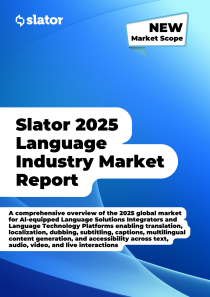
So much is changing, that Slator has redefined language service providers as Language Solutions Integrators (LSIs) and translation management systems as Language Technology Platforms (LTPs) in the Slator 2025 Language Industry Market Report. The new designations reflect an undeniable transformation both in service offerings and the technology that enables them.
Slator 2025 Language Industry Market Report
The 150-page report offers a comprehensive view of the 2025 global market — with market sizing, AI capability breakdowns, buyer insights, use cases, survey data, and projections through 2030.
Democratized language AI notwithstanding, enterprise-level results are still best left to language services industry pros. In the midst of the AI shift, the AI trail-blazing sector remains the best qualified to take enterprise global content into its next phase. Many traditional language services and technology providers are feeling the pressure, though, so we wanted to know how they are faring so far in 2025, compared to 2024.
Close to a third (29.0%) of respondents have actually seen a strong decline in growth. Almost a quarter (24.2%) have experienced some growth, while things have been flat for about one in five (21.0%). The rest have either seen strong growth (16.1%) or a small decline (9.7%).
Is the Healthcare Interpreting Growth Spurt Nearing Its End?
US-based AMN Healthcare Services reported a revenue decline for Q1 2025 in a May 8, 2025, earnings call for its Technology and Workforce Solutions segment, home of its language services offering.
Language services actually generated USD 75m in revenue for AMN, a 5% increase from the prior year, but a 2% decrease sequentially. This marked the first sequential downturn for the division since 2020, when the company added the capability via its Stratus Video acquisition.
AMN CEO, Cary Grace, attributed this decline to heightened competition and price pressure amid industry consolidation — an example of which is Propio’s string of acquisitions since 2022. At the same time, Grace highlighted AMN’s competitive advantage in quality and onshore interpreter supply, noting that some clients have returned after trying other vendors.
Interpreting services have consistently performed strongly for LSIs of all sizes, and we wanted to know if readers think the growth run in US healthcare interpreting is over. Most respondents (45.0%) believe it is still too early to tell. About one in three (30.0%) do think it is over, and a quarter (25.0%) think it is not over at all.