


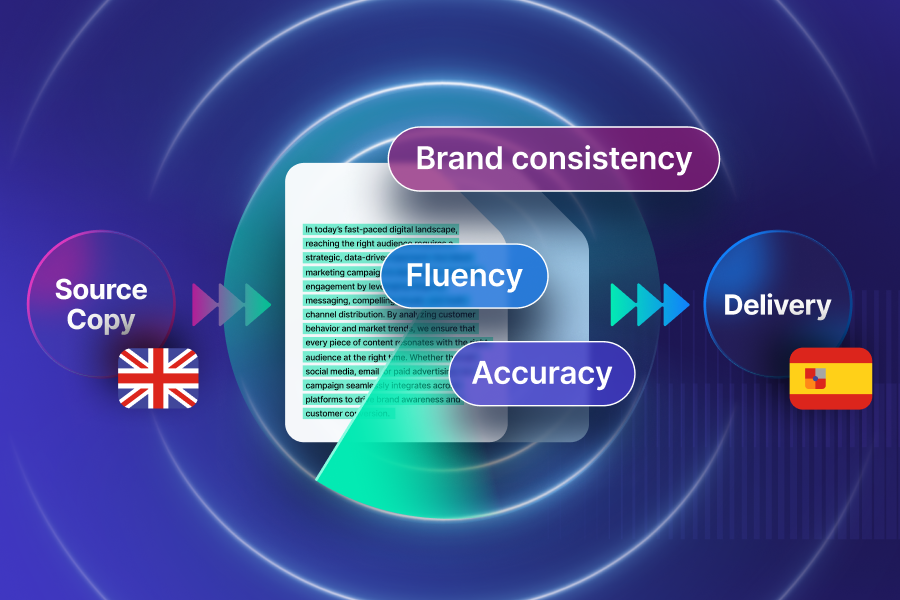
Finding automated ways to measure linguistic quality at scale has long been the focus of the localization industry. We now have a huge array of tools at our disposal including automated metrics (such as BLEU, COMET), post-edit signals (TER, edit distance) and Quality Estimation systems (such as Phrase QPS). All of these provide a perspective on linguistic accuracy.
But what if these metrics are no longer telling us the full story? What if measuring linguistic accuracy alone means we’re missing the bigger picture?
A Broader Content Context
Localization no longer operates in isolation. It now sits within a broader content strategy, one that spans marketing, documentation, support, and user experience. As companies scale globally, content is created and delivered across a wide array of platforms and languages. With the rise of large language models (LLMs), this content is increasingly dynamic, generative, and tailored.
In this context, traditional quality evaluation methods are beginning to show their limitations. They were not designed to assess whether a translation resonates with a target audience. They were built to check if a segment is linguistically sound. That is important, but it is not the same as ensuring content is resonant.
The Rise of LLMs and Adaptation
LLMs are not just changing how content is translated. They are reshaping the very nature of content itself, by changing how it is conceived, customized, and created. Rather than working from a single, static source text, content teams can now generate and adapt multiple variants for different regions, demographics, and tones. This has introduced a creative, non-deterministic layer into multilingual content generation.
You can now generate ten different versions of a product description, each tailored to a different market. The question becomes less about correctness and more about performance. Which one drives conversions? Which one engages the user? Which one results in action?
This is not something traditional segment-level evaluation is equipped to answer.
The Problem with Current Evaluation Methods
Most automated evaluation systems today work on single segments, disconnected from the surrounding context. This makes them blind to some of the most important factors in localization.
They struggle with:
- Document-level consistency, such as brand voice, gender usage, and tone
- Adherence to customer-specific terminology or stylistic preferences
- Cultural nuance and conventions, like date formats or legal phrasing
- Fitness for purpose, particularly when content is meant to persuade or engage
Even newer AI-based annotation tools, while more context-aware, face scalability challenges. They cannot be applied as widely or as efficiently as traditional QE systems.
Meanwhile, metrics like COMET or BLEU provide only a partial view. They tell us how closely a translation matches a reference, but they say nothing about whether the translation helped the end user achieve their goal.
From Linguistic Quality to Fitness for Purpose
The fundamental goal of localization is not just to reproduce meaning. It is to deliver an experience. A user in Japan reading content translated from English should feel as if the content was written for them. Not just linguistically, but emotionally and culturally.
This is what fitness for purpose aims to capture. It is not about word choice. It is about impact. Did the content help a user sign up for a service, understand a product, or feel confident about a purchase?
If we keep measuring only grammar, we risk ignoring what actually matters.
Why Outcome-Based Evaluation Matters
Many of the metrics that reflect true content success are not linguistic. They are behavioral. They include:
- Engagement depth (scroll depth, time on page)
- Conversion impact (click-through rates, purchases)
- Sentiment shift (user reaction, tone perception)
- Retention and user flow metrics
- Market-specific performance indicators
These are the kinds of signals that product, marketing, and CX teams care about. They are the KPIs that determine whether content is working. And yet, localization is often left out of that conversation.
The industry needs to start asking how translated content contributes to these outcomes. It should no longer be considered an afterthought, but as a core part of evaluation.
Challenges and Considerations
To be clear, outcome-based evaluation is not universally applicable. Not all content is designed to convert or engage. In domains like medical triage or legal compliance, accuracy and clarity still take precedence over engagement.
But for high-impact content, for example, marketing campaigns, user onboarding flows, support journeys, the focus must shift. The challenge is that these metrics often sit with other teams. Localization does not always have access to them, let alone the ability to influence them.
This requires a change in mindset. It means building stronger partnerships with content stakeholders. It means aligning on shared goals and outcomes. It may also require experimentation.
For example, instead of using a single translation, try A/B testing multiple versions. Use LLMs to generate stylistic variations, then monitor which one performs better. Over time, this creates a feedback loop that connects localization directly to performance.
A Way Forward
Linguistic quality will always be foundational. But it is no longer sufficient on its own. It does not reflect whether a translation feels right, lands well, or drives behavior. As LLMs expand the creative possibilities of localization, the tools we use to measure success must evolve as well.
Outcome-based evaluation does not replace existing methods. It complements them. It adds a layer of insight that aligns localization with business value. It allows teams to speak in the language of impact rather than just accuracy.
This is not about chasing perfection in language. It is about recognizing that the true goal of localization is resonance. The only way to know if a translation connects is to look at what happens after it is delivered.
That means asking new questions, gathering new data, and broadening the scope of what we measure.
Because if we only measure what is easy to count, we may be missing the point entirely.