The “preamble” portion of the text gives justification for the resolution by highlighting demographic statistics showing the large population of limited English proficient (LEP) people in the US, existing laws that mandate language access, such as Section 1557 of the Affordable Care Act, and precedent from state-level governments that already acknowledge “Language Access Month.”
A Symbolic Gesture
If passed, this resolution acknowledging the importance of language services would directly contradict President Trump’s March 2025 executive order (EO) declaring English the only US official language at the federal level, as well as the subsequent guidance from the Department of Justice, which encouraged cutting “non-essential” language services.
Notably, a simple resolution introduced by the House or the Senate does not require approval from the other house of Congress or from the President.
Instead, this type of resolution is used to address some action that is wholly within the purview of one house of Congress. Simple resolutions can also be used to offer advice to the executive branch, or to express the opinion of one house of Congress, but they do not become an enforced law.
Straight to the Point
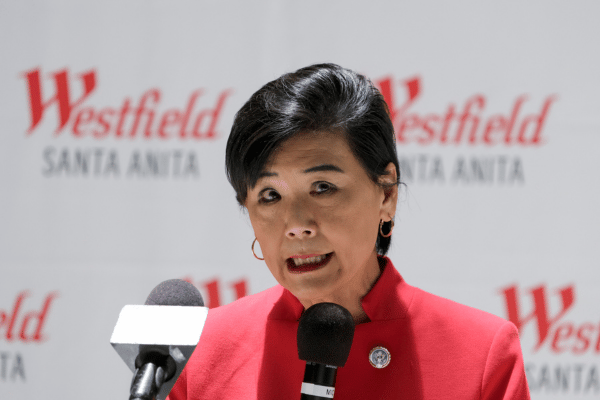
In an April 1, 2026 press release, Rep. Chu did not mince words when describing her motivation for introducing the resolution. She is quoted in the press release as saying, “The diverse languages spoken by our communities is something to celebrate, not punish or exclude … As the Trump Administration seeks to destroy language access across the federal government, it is important that we continue this fight and once again overturn these hateful policies.”
Some of Rep. Chu’s co-sponsors are quoted in the press release mirroring her strong stance on language access. For example, Rep. Adriano Espaillat, a Democrat from New York, is quoted as saying, “I am proud to co-lead this resolution recognizing National Language Access Month because language access is a civil right, not a privilege. At a time when people are being targeted for how they speak or who they are, we must be clear: discrimination has no place in our democracy.”
At the time of writing, H.Res.1148 has 22 co-sponsors, including two added on April 9, 2026, and the resolution has been referred to the House Committee on Education and Workforce.
Image: May 27, 2021: Rep. Judy Chu