Additionally, other efforts have already seen some success. For example, the SPEAK Act was passed as a rider on a large appropriations bill rather than as a piece of stand-alone legislation, and requires the Department of Health and Human Services (HHS) to draft standard guidance on integrating language services into telehealth communications.
At the same time, while some legislators have pushed back against the Trump administration’s English-only language policies, other state and federal institutions have taken action to support them.
For example, the state of Florida has implemented new rules requiring driver’s license exams to be performed exclusively in English, and Alabama introduced state-level legislation that would do the same if passed.
In another case, state legislators in Wisconsin introduced a bill declaring English the official state language and allowing state agencies to use AI tools “in lieu” of qualified interpreters.
At the federal level, the “VOTE Act” was proposed by Rep. Abraham Hamadeh in March 2025. If passed, it would make states ineligible for certain federal funding if they provide ballots in languages other than English for federal elections.
Another New Bill
As the push both for and against language access continues in the US, a new bill has been reintroduced that pulls another hot-button issue into the mix: gun safety.
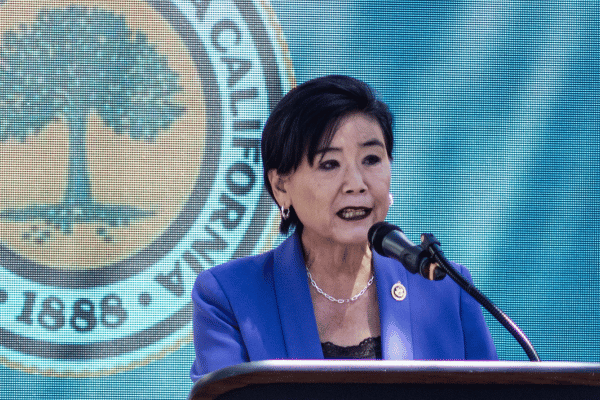
The bill’s full title is “a Bill to remove linguistic barriers to participation in Gun Violence Prevention Strategies.” It is also known as the “Language Access to Gun Violence Prevention Strategies Act of 2026,” and was reintroduced before the House of Representatives by Rep. Judy Chu on January 21, 2026 (H.R.7170).
If passed, the bill would require the Department of Justice (DOJ) and the Department of Health and Human Services (HHS) to translate public-facing resources related to “gun violence prevention and firearm safety” into all “priority languages.” The bill defines “priority languages” as “at minimum, the 10 most spoken languages in the United States other than English.” The text also specifically states that this list “shall include Mandarin, Cantonese, Japanese, and Korean.”
The bill would also require the DOJ and HHS to develop public awareness campaigns aimed at increasing the awareness of “federally supported gun violence prevention strategies” among LEP communities in the US. The text specifies that these campaigns would have to use “in-language and culturally appropriate messaging.”
Slator Pro Guide: Growth Hacks for Language Technology Platforms
This 45-page Slator Pro Guide uncovers 10 proven strategies behind ARR growth in language AI.
Finally, the bill states that the Attorney General (AG) would be required to “ensure” that grant applications for federal funding related to gun violence prevention efforts “incorporate meaningful engagement” with LEP communities.
In a January 21, 2026 press release, Rep. Chu states that she chose to reintroduce this bill on the anniversary of a 2023 mass shooting in Monterey Park, California, which resulted in 11 deaths. The press release further states, “Monterey Park is a predominantly Asian American community, where many residents have limited English proficiency and were not made aware of how to exercise gun safety tools available to them.”
The Wider Context
It’s worth noting that all the language access legislation discussed above has been proposed, or passed, as the US approaches a “midterm election.” At the time of writing, President Trump’s own party holds a majority in both houses of Congress. However, in November 2026, one-third of the Senate and all the seats in the House of Representatives will come up for election.
At that point, bills like the Language Access to Gun Violence Prevention Strategies Act may become logical talking points for candidates within the larger context of the Trump administration’s language access policy, especially as it relates to the administration’s controversial treatment of immigrant communities in the United States.
At the time of writing, the Language Access to Gun Violence Prevention Strategies Act has been referred to both the Committee on the Judiciary and the Committee on Energy and Commerce.