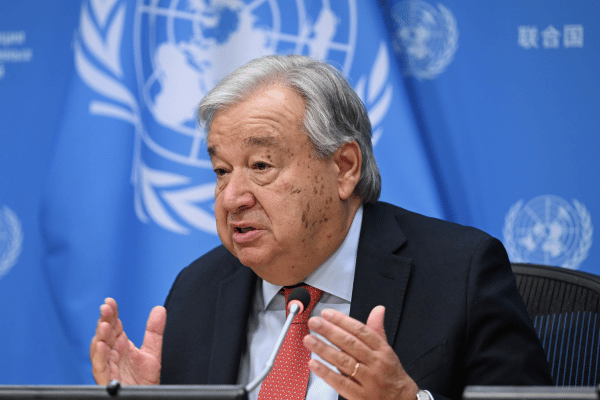
Without the payment of annual dues, Guterres warned, the New York headquarters faces a potential shutdown by August 2026.
In the wake of Guterres’ letter, institutions including the WFD and Human Rights Watch noted that these constraints have effectively shuttered essential services, a category that by mandate includes language and accessibility rights.
So far, the UN has slashed International Sign (IS) interpreting and live captioning, while also limiting spoken language interpretation and document translation.
Inside the UN itself, the Office of the UN High Commissioner for Human Rights (OHCHR) (download) warned during a meeting on February 9, 2026, that reductions in interpretation and translation support have dire consequences for the organization’s mission.
UN Deputy High Commissioner for Human Rights, Nada Al-Nashif, said in the meeting that she notes “with profound concern that one of the services affected would be the provision of accessibility measures that enable the full and effective participation of persons with disabilities in the work of the Council.”
The UN Committee on the Rights of Persons with Disabilities (CRPD) also issued a statement (download) warning that these cuts constitute a denial of reasonable accommodation and amount to discrimination against deaf and hard-of-hearing participants.
A Growing Crisis
Language access and accessibility issues attributed to insufficient funds at the UN go as far back as late 2023. By early 2025, the UN Office at Geneva (UNOG) confirmed that austerity measures remained in place, leaving the office unable to hire external interpreters. This has resulted in incomplete language coverage and the total suspension of international sign language services at many meetings.
Slator Pro Guide: Growth Hacks for Language Technology Platforms
This 45-page Slator Pro Guide uncovers 10 proven strategies behind ARR growth in language AI.
The timing is particularly paradoxical. In January 2026, the UN published updated Accessibility Guidelines (download) for data collection, which explicitly state that persons with disabilities must not be excluded for lack of reasonable accommodation.
Advocacy groups and delegates are now demanding an immediate restoration of these services, arguing that the UN is sacrificing its human rights for all mandates in the name of fiscal survival.
However, the UN is owed billions of dollars, especially by the United States, which, under the Trump Administration, has not paid the approximately USD 2.2bn it owes in dues for 2025 and 2026, according to a senior UN official who briefed media outlets on the agency’s budget crisis.
This retreat marks a sharp reversal from the progress made following the 2019 UN Disability Inclusion Strategy (UNDIS, download), which transitioned accessibility from a welfare consideration to a core organizational mandate. During that period, the UN consistently provided IS interpretation and live captioning, allowing deaf experts to engage on equal footing.
While some agencies have explored AI to automate complex language tasks (download), these projects remain underfunded and lag behind the private sector. For now, the UN is in what High Commissioner for Human Rights Volker Türk described as “survival mode” on February 5, 2026.