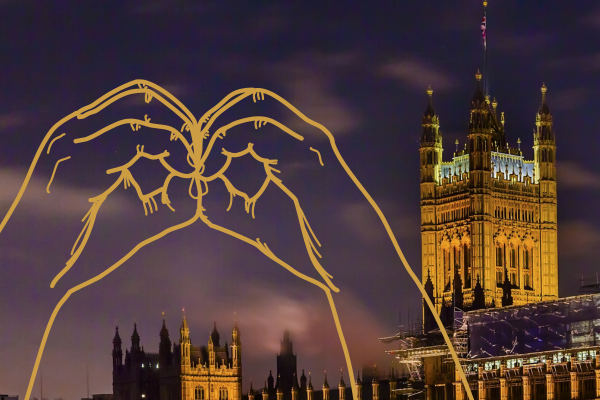
The committee received testimony from a panel of experts including, Dr. Jo Atkinson, a neuropsychologist and member of the BSL Advisory Board, Craig Crowley, co-chair of the BSL Advisory Board, and Rebecca Mansell, chief executive for the British Deaf Association.
After the BSL Act 2022 was passed, the BSL Advisory board was created by the UK government to advise them on issues related to using BSL in public communications and other “key issues facing Deaf people.”
The British Deaf Association (BDA) is a “deaf-led” non-profit organization in the UK that advocates for deaf linguistic rights, access to services, and full participation in the “wider society.”
During the evidence session, the panelists gave testimony in BSL with on-site interpreters facilitating communication with the committee members. Some of the major discussions addressed emergency and medical services, participation in government/parliamentary proceedings, AI technology, and BSL education.
The BSL Act of 2022
The BSL Act 2022 recognized British Sign Language “as a language of England, Wales and Scotland” at the national level. It also required the Government to periodically produce a “British Sign Language Report” describing what “relevant departments” have done to promote the use of BSL in their public communications.
Opening the testimony, all three panelists agreed that the BSL Act 2022 was an important step forward.
Rebecca Mansell said, “we feel that finally our language and culture are recognized.” Craig Crowley noted that, “It [the Act] has brought BSL to the public and political conversations, which had not happened previously.”
At the same time, they acknowledged the need for further progress. Dr. Jo Atkinson noted that “there are other situations where there is not sufficient legal structure to support Deaf and deafblind people and the interpreters that we require.”
Access to Services
The panel pointed out a marked disparity in services in Scotland compared to England and Wales. Referring to the British Sign Language Act (Scotland) 2015, Mansell said, “It is clear that the Scottish legislation is much stronger than the BSL Act 2022.”
Atkinson stated that Contact Scotland BSL, a free video relay interpreting service for BSL users in Scotland to call service providers, “was funded and supported via the [Scottish] BSL Act. It was the Act that provided the framework to allow that to be established. We do not have a similar thing in England and Wales.”
“At the moment, we cannot call the gas, the water or the electricity; we cannot contact hospitals or the council; we cannot report safeguarding issues if we have concerns about children or young adults. These services need to be national as soon as possible.” — Dr. Jo Atkinson, Clinical Neuropsychologist and Member of the BSL Advisory Board
The panelists also discussed the loss of the BSL Health Access service, which was created during the Covid-19 pandemic for remote medical consultations. Mansell said, “for the first time, Deaf people in England and Wales could access signed communication with […] any health professional. […] To have an interpreter in your pocket that you could use for communication was incredible.”
Discussing the loss of this service, she said, “once the pandemic was over, we were back to square one. […] I have to wait two weeks for an interpreter when I need an urgent appointment immediately.”
When asked about emergency services, the panel discussed 999 BSL, an app that allows deaf people to contact emergency services in BSL. While praising the service, Mansell also pointed out that this communication service ends when the ambulance arrives. She argues interpreters should be available from the initial call through to hospital arrival.
Notably, this weak BSL access is not limited to medical services. Atkinson noted “at the moment, we cannot call the gas, the water or the electricity; we cannot contact hospitals or the council; we cannot report safeguarding issues if we have concerns about children or young adults. These services need to be national as soon as possible.”
Slator 2025 Language Industry Market Report
The 150-page report offers a comprehensive view of the 2025 global market — with market sizing, AI capability breakdowns, buyer insights, use cases, survey data, and projections through 2030.
Access to Parliament
A barrier to entry was observed for deaf citizens running for election in parliament. Mansell mentioned David Buxton, a former chair of the BDA who, “has been trying to stand for election, but the challenges he faces in obtaining interpreters, having to speak to voters and not being able to communicate creates a real barrier.”
Atkinson further noted that, “there have previously been funds available to potential Members of Parliament who require reasonable adjustments in order to stand for election, but those funds have been closed.”
“One of the issues is that in Parliament we cannot give commentary in BSL, because Hansard cannot record in BSL. […] That is also why we need interpreters; it is not just to make access for us, but so that we can contribute in our own language as well.” — Dr. Jo Atkinson, Clinical Neuropsychologist and Member of the BSL Advisory Board
When the panel was asked about BSL accessibility to parliamentary proceedings and debates, Atkinson used herself as an example, saying, “I am chair of the health and social care sub-group on one of the Government’s own advisory boards, and yet I watch health debates in Parliament that I cannot access.”
Atkinson also described issues with Hansard, the system for recording all parliamentary discussion. She argued that, beyond access to records, there is also an impact on the deaf community’s ability to participate in Parliament.
She stated that, “one of the issues is that in Parliament we cannot give commentary in BSL, because Hansard cannot record in BSL. […] That is also why we need interpreters; it is not just to make access for us, but so that we can contribute in our own language as well.”
BSL Education
While discussing early childhood education and newly diagnosed deaf children, Mansell reported confusion from many parents who have spoken to the BDA. She notes that, “they are receiving conflicting information from the professionals they meet, with some saying to use sign language, and others saying, ‘No, no, it will affect their speech development.’”
She remarked that this conflicting advice echoed what her parents received when she became deaf 48 years ago, suggesting a notable lack of progress.
Mansell also observed, “across the UK, we have hearing aids and cochlear implementation available free, yet our parents have to pay for sign language,” calling this a “structural inequality.”
Atkinson highlighted the risk of reliance solely on hearing aids and cochlear implants, saying, “for children who have not been given both languages, when the technology fails they have no language. That is real trauma.”
2025 Slator Pro Guide: Translation AI
The 2025 Slator Pro Guide Translation AI presents 15 impactful ways that AI can be used to enhance translation workflows.
The discussion of AI tools for BSL was met with cautious optimism from the panel. Atkinson described AI as a potential “Deaf gain,” arguing that successful BSL AI tools could have “far reaching effects” potentially helping more than just the Deaf community in areas like “sports coaching, physiotherapy and gesture recognition.”
However, Atkinson also reported that, “many Deaf people are fearful that new barriers will be created with the advancement of AI.” She pointed to the historical example of the telephone, which pushed communication technology ahead but created a ”fresh barrier for the Deaf population.”
Concern was also expressed regarding the economic perspective of AI for BSL. Atkinson warned that “this must not be introduced just as a cost-cutting measure by Government,” highlighting the need for any AI implementation to have a “genuine benefit.”
Mansell expressed concerns about AI developers trying to “commodify” BSL. She reported that “the BDA receives many requests for partnerships in this area.” She gave the example of a particular group that proposed a design for AI-powered BSL gloves. However, none of the developers could sign, and they were not familiar with Deaf culture or history.
She advised that “the right processes [be] in place when you decide on an investment”, emphasizing the need for linguistic and cultural knowledge from the Deaf community.
All three panelists highlighted the need for the Deaf community to be intimately involved in the development of AI for BSL, and in decision-making around implementation.
At the time of writing, the WEC has not released any reports related to this inquiry.