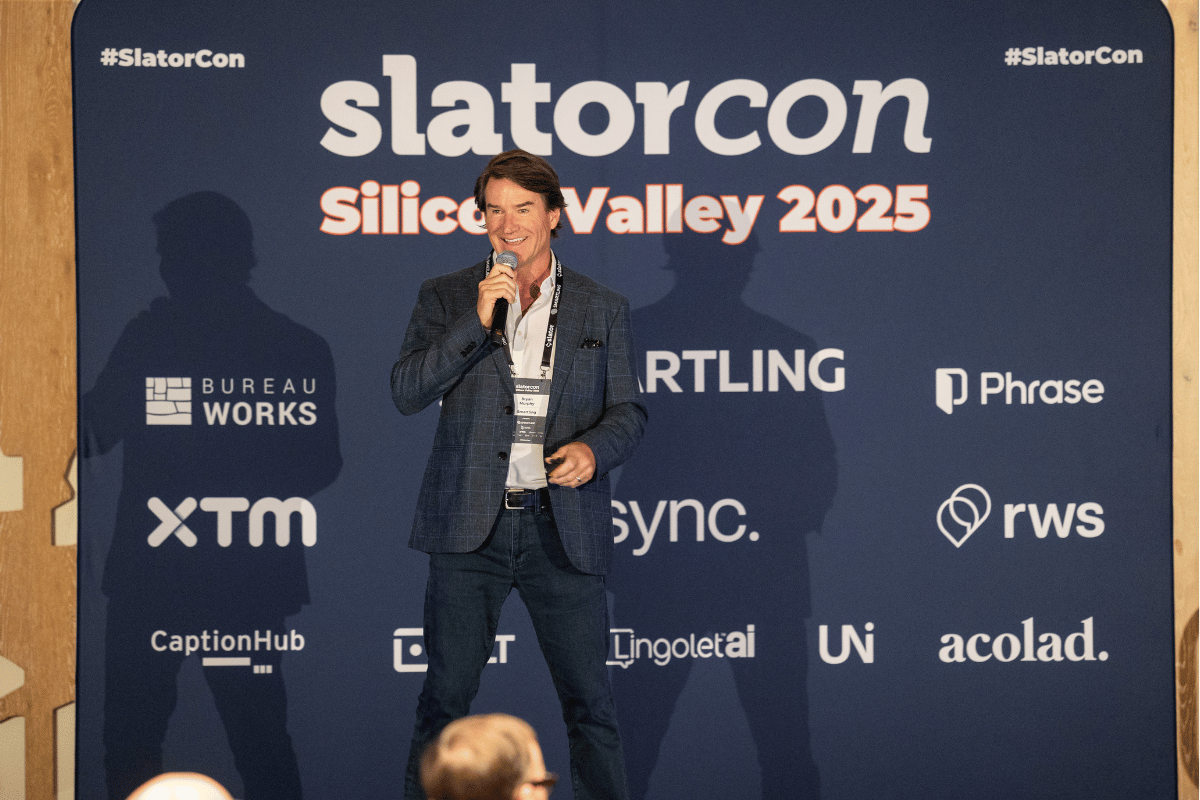
Bryan Murphy, Smartling’s CEO, delivered a compelling presentation on the transformative impact of AI on the localization industry during SlatorCon Silicon Valley 2025, offering his perspective on the strategic value of localization in the age of AI.
His core message was that AI is not a threat to the industry but a catalyst for unprecedented growth and efficiency, providing a framework for localization professionals to articulate their value to the C-suite that he backed with research data and economic principles.
Murphy’s presentation positioned high-quality localization not as a cost center but as a powerful engine for business growth. He cited figures showing that companies with robust localization programs are 1.5 times more likely to report growth and reframed localization as a tool to significantly increase conversion rates and click-through rates.
Partner spotlight
Riding the AI shockwave
The future of AI adoption depends on trust, ethics and human expertise.
Arguing that the main reason companies do not localize more content is not a lack of interest, but the traditional cost and time barriers, Murphy identified an untapped opportunity with unlocalized content — estimated to be worth up to USD 46bn. To him, this is content that would be translated if the process were more affordable and efficient.
“That represents the ‘unvended market.’ … If we had the right automation, if we had the right integration, if we had the right cost structure, companies would translate that content.” The CEO added that AI will help the localization industry grow, address that potential market, and respond to the C-suite concerns about cost and time.
The Real ROI
Throughout his presentation, Murphy circled back to ROI and the C-suite’s focus on growth. In his view, while it is difficult to get a consistent picture due to varying levels of “localization maturity” across different companies, research indicates a clear connection between quality localization and business growth.
Murphy underscored that this ROI is not just a theoretical concept. “75% of the internet does not prefer English,” he said. The opportunity for growth is massive, and by making content localization more accessible and efficient through AI, companies can exponentially increase the amount of content they translate, which in turn drives an organization’s overall growth.
This shift from a traditional, expensive, and time-consuming service to a cost-effective, automated platform creates a tangible ROI opportunity that business leaders can easily understand and support, commented the CEO.
Referring to Jevons Paradox, an economic principle that states that when a resource becomes more efficient or cheaper, its usage increases dramatically, he applied this to translation, showing that, as Smartling’s cost per word decreased by 60%, content usage went up by 255%.
He added that localization drives key marketing metrics like improved conversion rates and higher click-through rates for advertising, and that by reframing localization as the “ultimate personalization” tool — a holy grail for marketing professionals — teams can demonstrate how their work directly contributes to a company’s bottom line.
Why DIY Language AI May Not Be a Good Idea
Citing an MIT study that found that 95% of generative AI pilots fail due to hidden costs and a lack of expertise, Murphy shared his own failed attempt at a DIY AI project, asserting that the future of localization lies in “purpose-built AI applications” and platforms, not generic large language models (LLMs).
“LLMs can’t do it alone. Neural machine translations are lacking in certain things that we do here. So it’s the combination of both that’s resulting in really positive gains.” — Bryan Murphy, CEO, Smartling
He stressed that, while the cost of using AI models is low, the cost of building and maintaining a production-grade system is prohibitively expensive.
Additionally, commented Murphy, LLMs have limitations and high error rates for translation, contrasting their performance with purpose-built, trained machine translation (MT) and AI translation platforms.
“LLMs can’t do it alone. Neural machine translations are lacking in certain things that we do here. So it’s the combination of both that’s resulting in really positive gains,” added Murphy, positioning Smartling as a transformative AI translation-as-a-service layer that combines the strengths of various technologies, including NMT and LLMs, to achieve superior results.
Featured
Partner spotlight
Boost Language Access
Improve health outcomes and ensure compliance for individuals with LEP