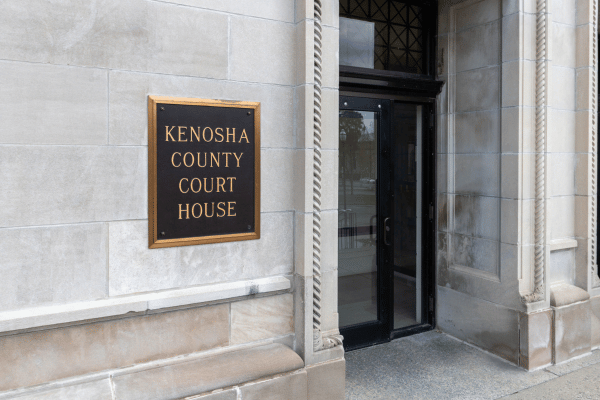
As Wisconsin Public Radio reported in June 2025, supporters say the bill could expand language access despite a shortage of interpreters, which has forced judges to delay hearings.
Wisconsin’s challenge with interpreters were already well-established. In 2024, a legal reform group asked the Wisconsin Supreme Court to require municipal courts to use trained interpreters in all cases involving people with limited English proficiency (LEP). (A state statute entitles all people with LEP, and those who are deaf or hard of hearing, to a qualified interpreter during court proceedings.)
According to the Wisconsin State Journal, the demand for courtroom interpreters is growing, with the LEP population comprising more than 167,000 Wisconsin residents, or nearly 3% of the state’s population.
Slator 2025 Legal Services and Language AI Report
The 90-page report analyzes language services, AI, and technology demand from legal services organizations in the public and private sector.
Wisconsin currently has 135 certified court interpreters on its rosters, though not all of them live in Wisconsin; of 71 certified Spanish court interpreters, for instance, 31 live out-of-state.
At the same time, the cost of providing interpreters continues to rise. Individual counties absorb the bulk of interpreting costs, with the state providing partial reimbursement.
Now, some politicians want the state to allow courts to take what they see as the next step in making language access more affordable, by permitting artificial intelligence for translation and interpreting.
Has the Jury Reached a Verdict?
Representative Dave Maxey (R-New Berlin) introduced another bill, Assembly Bill 292, in May 2025, with support from 20 other representatives. The bill has since been referred to the Judiciary Committee.
In addition to allowing a court interpreter to work via telephonic or “live audiovisual means” in a criminal trial, which was previously not allowed, the bill amends and creates statutes related to the use of AI and other “machine assisted translation” in court proceedings. The language AI technology can be used “in lieu of or in addition to an interpreter.”
Slator 2025 Language Industry Market Report
The 150-page report offers a comprehensive view of the 2025 global market — with market sizing, AI capability breakdowns, buyer insights, use cases, survey data, and projections through 2030.
Counties that prefer to use human interpreters can continue to do so; instead of mandating the use of AI, the bill would permit courts to use AI at their discretion in civil and criminal proceedings and in certain municipal proceedings.
The Wisconsin State Journal reported that, although cosponsor Sen. Kapenga has described the bill as a first step in a pilot program, the proposal does not outline any specifics or guidelines, despite the complicated terminology and potential consequences associated with court interpreting and translation.
Wisconsin is not the only state looking to AI to support language access in courts. The Ohio Supreme Court is considering a proposal that would allow GenAI to “assist with translation and interpretation in legal settings.” That rule, however, would not permit AI interpreting for any “substantive legal proceeding, case, or court function.”