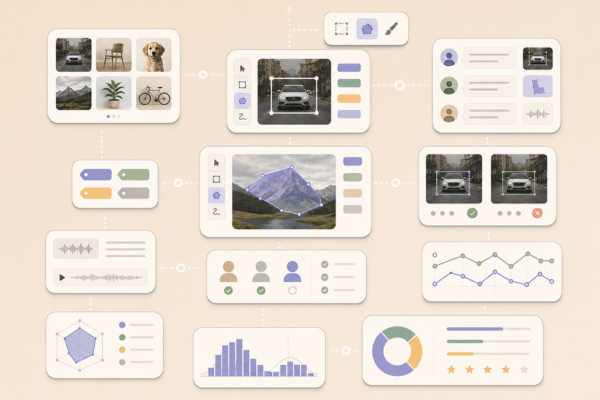
Data-for-AI demand follows AI model development and deployment. As model architectures and deployment patterns have evolved, so too have the forms of data required to build and operationalize them. AI systems now depend on a wide range of datasets that shape model capability, domain performance, and operational reliability across languages, industries, and modalities.
Much of this data is human-shaped, embedding judgement, expertise, and domain knowledge into the systems increasingly used across the global economy.
Over the past two decades, demand has moved through distinct phases. Each phase is defined by the category of data that becomes strategically central to progress; i.e., the data required to move AI beyond its prevailing limitations. Today, general capability exists, but making it reliable, controllable, and usable in real-world environments has become the central challenge.
AI Data Demand Multipliers
Current data into two categories: capability data, used to build baseline model performance, and deployment data, which adapts models for specific contexts and ensures they are useful, safe, and suitable for real-world use.
While capability data remains important, growth is most dramatic in deployment data.
Capability and deployment data requirements multiply as AI adoption is extended across domains, languages, modalities, and operating environments. There are at least five key expansion dimensions across which AI is extending and acting as a demand multiplier.
Those dimensions and the data demand impact are:
- Industry and domain expansion — multiplies demand for domain adaption and evaluation data across industries.
- Language and geography — greater need for large-scale foundation model data, adaption, alignment and evaluation data across languages.
- Vision and physical environments — increases demand for vision data.
- Spoken interaction — greater demand for voice and speech data.
- Multimodal AI — increases demand for multimodal and cross-modal datasets.
Buyers and Suppliers
The four main buyer segments driving demand for AI data are frontier labs, AI product builders, enterprise and government deployers, and Sovereign AI programs. Not surprisingly, frontier labs have the highest level of demand, though Sovereign AI programs are fast-emerging as an important source of demand for AI data.
The AI data supply chain supplier landscape can be organized into three layers: data production, data infrastructure, and data assets.
The ecosystem ranges from organizations that produce and label training data, to platforms that manage data workflows, and providers that license or distribute datasets for model development.
While the market is often associated with large-scale data providers, the ecosystem is more diverse, combining industrial data operations, specialist providers, software platforms, and rights holders.
Another important aspect of the data-for-AI market is that it is remarkably human-centric. The industry relies on a globally distributed workforce supported by operational infrastructure spanning multiple regions. An ability to effectively recruit and manage human specialists and experts has become a key differentiator for suppliers and a strategic asset for buyers.
Check out the 160-page report for a comprehensive view of the emerging global market for Data-for-AI, including much more on data suppliers, buyers and other key market dynamics, including many examples of leading players in the industry.