The state’s Language Access Law already requires agencies to offer interpreting services in a user’s primary language (including American Sign Language); to translate vital documents into the top 12 languages spoken by New Yorkers with LEP; and to post and update a language access plan on their agency website every two years.
Now, the OLA, under the New York State Office of General Services, is taking a step toward possibly “in-sourcing” language services.
“This way NYS employees who speak a language other than English could further their professional development and help foster more culturally responsive interactions with government services,” the RFP states. “The OLA will develop a Language Access Certification Program offering language assessments and training for NYS employees that speak a language other than English and are interested in leveraging and honing their Spanish interpreting skills.”
Beyond furthering the careers of eligible bilingual employees, the stated mission is to improve the quality of language services offered and, ultimately, access for LEP New Yorkers.
‘Languages Other Than English,’ or Spanish?
The RFP is separated into two unique lots (intended to be awarded to different contractors), an initial testing phase, followed by training, and another test.
Lot 1 covers spoken language fluency testing, in line with the Interagency Language Roundtable (ILR), for “English, Spanish, and other languages”.
However, proposers must specify “the minimum level of Spanish and English proficiency” for admission to the training program. “This will be in line with ILR scale and interpreter training industry best practices,” the RFP explains.
Lot 2, meanwhile, entails the interpreter training program and interpretation skills testing (both specified as pertaining to spoken language).
The curriculum for the public service training program should comprise at least 40 hours over four to six months, and should be “relevant to NYS workforce in Spanish.”
The language solutions integrator (LSI) providing the training must also be equipped with a platform that trainees can use to access resources, such as workbooks and bilingual glossaries, and to self-pace their learning, though there must also be live sessions and informational group calls during which they can practice their skills and ask questions.
A test after the training program — or a different program or comparable experience — will evaluate an employee’s skills and “whether the employee knows the information and possesses the skills necessary to be considered a public service-qualified interpreter by their agency.”
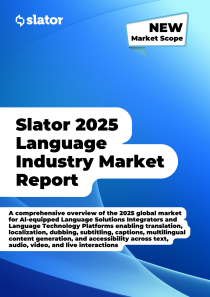
Slator 2025 Language Industry Market Report
The 150-page report offers a comprehensive view of the 2025 global market — with market sizing, AI capability breakdowns, buyer insights, use cases, survey data, and projections through 2030.
In other words, the standards are jointly set and enforced by the contractor, the OLA, and a given agency, rather than by an outside professional organization.
Confusingly, RFP materials state that the pilot program will focus on Spanish and English for a small group of State agencies “based on NYS Language Workforce Survey findings and agency staff interest.” But the RFP also mentions plans to test 300 candidates for fluency in English and Spanish, “plus 100 tests in other languages as needed.”
Between 75 and 150 candidates are expected to participate in the English-Spanish training program.
In evaluating proposals, the cost proposal will account for 30% of a bidder’s score, with technical evaluation covering the remaining 70%. The latter includes proposer experience (26.5%), plan of operation (20%), and staffing plan (20%). An additional 3.5% will be added for companies certified as women-owned, minority-owned, service-disabled veteran-owned, or small businesses.
The OLA will calculate the total cost of the contract based on 70% of the primary contractor’s grand total quote and 30% of the secondary contractor’s, though the contract value is still an estimate and not a guarantee.
The LSI selected must also agree that the rates paid by NYS Office of General Services throughout the contract must be equal to or lower than rates for other customers for similar services.
The contract resulting from the RFP will be in effect for one year, with two optional one-year renewals. Bids are due August 19, 2025.