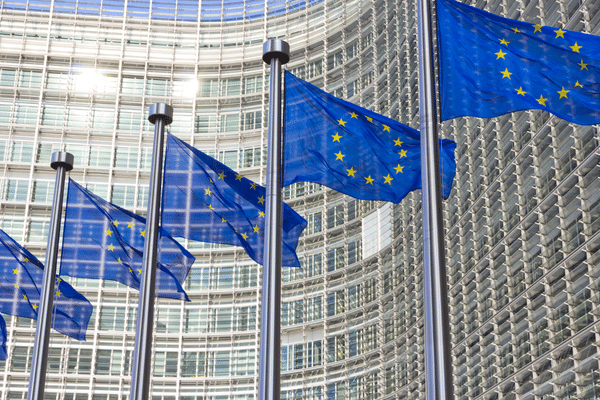
“On average each week, we mobilize 2,000–3,000 people in these meetings,” Calavera said. DG SCIC covers all 24 EU languages, plus international sign language, and any other language required as part of the EU’s multinational interactions.
Calavera revealed the measures adopted by SCIC to maintain a high caliber across its 500 staff interpreters and 2,900 freelance interpreters. Along with accreditation tests and ongoing quality measurement, newcomers receive consistent peer assessment from senior interpreters to ensure transfer of knowledge.
Slator Interpreting Services and Technology Report
60-page report on the growth industry of interpreting, featuring analysis by mode, setting, geo, buyers, business use cases, RSI, OPI, VRI. Incl. market size estimate.
According to Calavera, about 80% of DG SCIC interpretation is currently deployed in-person. while 20% is delivered in a hybrid format, involving some configuration of speakers, participants, and interpreters taking part remotely or in-person.
Remote interpreting platforms enable flexible meeting arrangements and help SCIC minimize its carbon footprint. However, explained Calavera, platforms have also ushered in new challenges around technical preparation and sound quality.
Cybersecurity is another area of focus. “The level of cyber attacks has grown exponentially,” Calavera told the SlatorCon audience. “The EU is a known player in the world and we are much more prone to these attacks. We’re working hard to make sure our platforms are cybersecure.”
Future of DG SCIC Interpreting
Looking ahead, a labor gap appears to be looming. “We see there is less interest in interpreting as a profession,” Calavera said.
The DG SCIC is cooperating closely with universities on a range of measures to address the shortage. Objectives include ensuring that master’s studies in interpreting remain on the curriculum, and that graduates are ready for the DG SCIC’s accreditation process.
European Commission events are also changing, which in turn impacts the types and volumes of interpreting demand. Online meetings, such as the Future of Europe, now bring EU citizens together in online panels and conversations.
Such large, online fora need interpreting on a greater scale — and it is here that Calavera sees technology playing a vital role. “We are very much investing in tech,” she said. “The need for the human factor will remain, however technology such as text-to-speech and speech-to-text can simplify the diffusion of these events.”