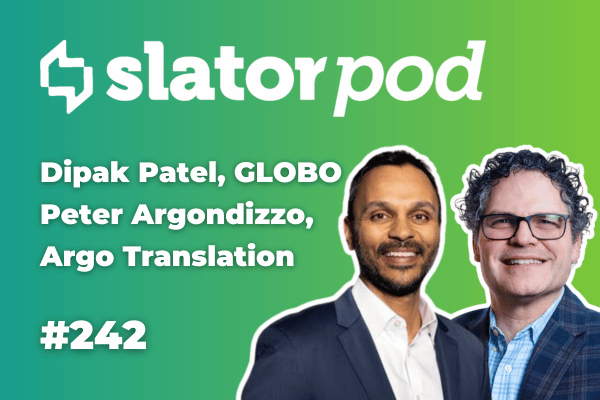
In response to President Trump’s executive order designating English as the official language of the US, SlatorPod gathered Dipak Patel, CEO of GLOBO, and Peter Argondizzo, CEO of Argo Translation, to discuss its implications for the US language industry.
The discussion highlighted that language access has long been a key part of US policy, particularly in healthcare, education, and legal services. Dipak pointed out that eliminating language services would create inefficiencies, making it harder for medical professionals to provide accurate care.
Peter emphasized the broader uncertainty the order creates as many organizations rely on federal funding for language services, and a lack of clear guidance could lead to reduced support in schools, courts, and public services.
Partner spotlight
Riding the AI shockwave
The future of AI adoption depends on trust, ethics and human expertise.
Both CEOs acknowledged that while this order presents challenges, the language services industry has historically adapted to change. Dipak suggested that financial pressures may push the industry to innovate, potentially accelerating AI adoption in interpreting.
While the long-term impact remains unclear, the consensus is that language access will persist — driven by business needs and market demand.
Transcript
Florian: Hey everyone and welcome to a rare emergency news-driven podcast here from SlatorPod about the order by the Trump administration which is designating English as the official language of the United States that came out on March 1st. Today on the podcast we have three experts. We have Peter Argondizzo from Argo Translation, the CEO. We have Dipak Patel, CEO of GLOBO, the interpreting and interpreting tech company. Then we have our very own Rocío Txabarriaga, Senior Research Analyst and Editor at Slator, who is also helping us provide context here. Hi Rocío, Dipak and Peter.
Dipak: Hello.
Peter: Hello. Thanks for having us.
Rocío: Hi everyone.
Florian: Very briefly, Peter and Dipak, give us a very short introduction, where you’re based, introduction about the company before we get started with discussing this executive order by President Trump.
Peter: My name is Peter Argondizzo. I’m the CEO and one of the Founders here at Argo Translation. This is really awesome because this week is our 30th anniversary and nothing says happy anniversary like crazy change, so that’s good. Previous to founding Argo, I was a project manager at a medical device manufacturer in Milwaukee where I’m originally from, and now I’m in the Chicago area. Thanks for having us, Florian. We focus by the way on written translation. We do all sorts of stuff, SharePoint, content management systems, you name it, all that sort of thing.
Dipak: Thanks Florian for also inviting me. Dipak Patel, CEO at GLOBO Language Solutions. We are a full-service language services company, meaning we provide on-site telephone, video interpretation, dabbling with AI as well as translation. We primarily focus on healthcare and we’ve been around for over 15 years. I’ve always been in healthcare for the past 25-plus years working with not just hospital systems but also insurance companies and pharmaceutical companies. I am based an hour outside of Boston, Massachusetts.
Florian: Thanks. Rocío, maybe a few words from you as well where you’re based.
Rocío: I’m currently based in Malaga, Spain and my background is in everything that has to do with language services from operational aspects of it. That’s mainly what I did on the LSP and the buyer side and I’m also an adjunct professor at a university where I teach translation and interpreting. At Slator I’m an analyst and I also work on some special research projects and consulting for the company.
Florian: Let’s get this started. Dipak, when you saw the executive order, what’s now three days ago, what was your initial reaction?
Dipak: More news that has happened in the last month than I can imagine. I want to dig deep because the first headline was obviously Trump signing an EO to make English the national language. My first reaction was I actually didn’t think it was that big of a deal. We have 30 states that already claim English to be the official language. Some states have more than just English. Then when I read a little bit deeper, his EO also talked about rescinding Clinton’s EO, which is all about providing more clarity to the Civil Rights Act, making sure that language access was under the umbrella of discrimination, as well as making sure that all federal agencies provided language services, had a language plan, as well as any sort of entities that received federal funding. When I read that part of the order, then I started to think more and more in terms of the implications, which I know we’ll talk more about.
Peter: This was a bit of a movement the last time he was in office. I think they were trying to get this done, and I think he was dissuaded the last time around. It just seemed like it was on the heels of an already crazy day out of Washington. I guess it’s part of that nationalistic feeling, if you will, to name it. At first, much like Dipak, I didn’t think much about it, but then I dug a little bit deeper and you start to dig a little bit deeper, and I know we’re going to cover all those things today, but, it was a little bit of a shock. My colleagues and the ALC group that I’m in, a lot of just confusion, panic, you name it. It’s just part of the craziness.
Florian: Did you learn about it from a WhatsApp group or on X or where did you see it first?
Peter: There’s an ALC group on WhatsApp and I started to see the chat just blow up, and I was like, oh, gosh, now what’s going on? There was some very colorful language in there, which is good. That’s great.
Slator 2025 Localization Buyer Survey
Slator’s survey of 50 enterprise localization buyers provides valuable insights on budgets, pricing, AI implementation, and expectations in 2025.
Florian: Let’s give some of the listeners here who are not based in the US some historical background about the language in the US. How and why was there no national language? For example, here in Switzerland, we have three national languages, and then I’m not even sure the fourth one has another kind of official label. Europe is very proud about labeling languages very accurately. What status do they have? There are layers there. In the US there just historically has been no national language at all. Does anybody want to comment on this?
Dipak: I got this question from a good friend who’s over in Europe and I had to think about it. A couple of thoughts, one is that the US prides itself on individual freedom. Be who you want, believe who you want, and think what you want. The other thing is if you think about when we were founded, independence, there were multiple languages being spoken. It wasn’t just English. It’s not like when the US was founded, we only spoke English. There were multiple languages that the population was speaking. Then the third one, just I’m first generation. We’ve been a country of immigrants, welcoming people in, no matter what they speak, no matter what they believe. I think for all those reasons, there was never a thought that we needed to have a national language. We all embrace the fact that people come here and speak different languages, and that’s a wonderful thing. That’s my take. I haven’t been in the heads of the past administrations to wonder why they didn’t do such a thing. I think one can guess in terms of the theme with some of the things this current administration has been doing, but that’s my take in terms of why there hasn’t been a national language in the US.
Peter: I would agree. I think past administrations have stopped short because I think there were some worries of alienating our immigrant population. This is a nation of immigrants, essentially. I’m first generation as well. My folks came over from Italy and we spoke Italian at home. My folks wanted us to go 100 miles an hour ahead with English. I think for most people, it is the de facto language, I guess. There’s no accommodation for it in the Constitution. It’s really kind of a nothing burger on the surface.
Florian: I was going to ask you, Rocío. You said there’s nothing in the Constitution, so this is an executive order. Rocío, for non-US listeners, what is an executive order? This is not the Constitution and what’s the level here?
Rocío: Before I give that definition, there’s actually a comment on Peter’s take on this, in which he mentioned the languages that were already there, and there’s nothing in the Constitution, yes, specifically. We also can’t forget that there were First Nations in the United States, so Native American languages, like Navajo today, for instance, there are entire communities where that’s the official language, not English. Dipak also made the point that some states also have their own official languages. We have nations within the nation that are free to speak whatever languages they use, so that’s very important. I believe, and a lot of people actually have said this, that this was left out of the Constitution on purpose so that people would have that freedom. Now, about what an executive order is, and I have to disclaim that I’m not a legal expert, I’m just somebody who has been on this journey from the start. A ruling that is issued by the President of a country, in this case the United States, directing an executive branch of the government, like the Department of Justice, to implement it. In this case, this executive order actually has language that directs the Attorney General to provide new guidance as the original Clinton executive order was rescinded.
Florian: Okay, so tell us a bit more about the history of language access. Now, we’ve heard from Dipak, also the Clinton order that built on the Civil Rights Act. How long has the term language access been around? What’s the history there and what would be the implications going forward, Rocío?
Rocío: Although I cannot speak of a precise moment when language access became a term per se, it really started appearing in legislative documentation, both federal and state documentation, in the late 1990s. That’s when we actually started working on standards beyond the courts because, at the time, we only had a truly organized court interpreting system, but nothing more. After that, a lot of groups like the National Council on Interpreting Health Care, there’s one, the IMIA, and many more, actually started working on the medical side. Language access became a term of the government, truly official, I would say, in that Clinton executive order 13166.
Florian: Peter, is that something you still remember? When the company was started, so maybe you can shed a bit of color on that?
Peter: Absolutely. From that era, we had legislation that impacted our industry in a huge way. If we think of the EU. Formally saying that, hey, anything that ships to the EU has to be translated. Some of that stuff was missing from the US and I think Clinton’s order was really the tipping point. We actually had a client in that era that sued under the Americans with Disabilities Act. A client walked into an office and requested information in Korean and was kind of rebuked, was mistreated, if you will, and under the Americans with Disabilities Act, brought a suit against the company. I think that’s an important point that I hope we discuss as well, that there are multiple paths here whether it’s civil rights or Americans with disabilities. There are multiple paths here. I think it’s not for the Trump administration to completely say, hey, there’s not going to be any language access provided under federal or state guidelines, it’s going to be very, very difficult. I think for me, a lot of the issue is too, is we can say what we want. You can go outside in a thunderstorm and say, no, it’s sunny. Well, you can say that, but you’re still going to get wet. The reality of it is whether you’re talking about a school administration, whether you’re talking about a courthouse, you’re going to be faced with either parents, people going through the criminal system, wherever it might be, in an office, that don’t speak English, and you’re going to have to figure out how to accommodate them.
Dipak: I wasn’t surprised when I saw if you think about what Trump ran on and some of the big issues that were really important to the population of the United States. Immigration was one in terms of just the influx of immigrants and immigrants that maybe were creating crimes, and just immigration as a whole was a topic. Then you have another topic which they addressed, which was DEI in terms of how much effort are we putting into diversity, inclusion, and equity. This is something that addresses both of them in a weird way. The fact that we’re going to make English the national language, we’re not going to provide services to folks that don’t speak English. I think at a macro level, that’s how you could view it. I think, though, if you get to the next level, in terms of the implications, some of the things that Peter is saying, it doesn’t make sense in terms of just the impact of all this. You think about healthcare and hospital systems. Yes, hospitals and providers are mandated to provide language services through 1557. Even if you remove that mandate, I don’t think there’s a world where hospitals will say, we’re not going to provide interpretation services. If you spoke to a doctor, I don’t think a doctor would say, I only do this because I have to. They do it because they recognize how important it is to be able to communicate and understand what people are thinking, and what people are feeling, and that benefits everyone. It makes the most time and not just for the patient, it makes the most time for that physician. Instead of having to spend 40 minutes trying to understand what’s going on, they only have to spend 15 minutes. Instead of that patient spending an hour and a half in the ER, they’re only spending 20 minutes in the ER, which frees up capacity. I think that’s the level of thinking we need to have around this, which I don’t think the administration has necessarily thought through yet.
Florian: This was on my list for things that would speak to basically the status quo just continuing. Basically, that is just generally good for business or for a hospital system or for just kind of efficient operations to service that population of 20, 30, 40 billion people of limited English proficiency in the US, so that’s almost a business case. Then you have things like state-level language access laws. There’s like the Sixth Amendment for criminal cases and other things. Peter, can you comment on that? Other areas where this executive order can kind of override or just has no kind of bearing or impact?
Peter: Absolutely. In the school systems, I think it’s going to be really important because remember, the school systems, while they do in some cases receive federal funding, that’s usually very regional or locally funded through the property tax base. I think local school districts are definitely going to continue doing business as usual. I think the issue becomes, does this change the vibe? Does it set precedence in some way? If the federal government doesn’t have to do something, then does that follow that at the state level, at the local level? There’s no requirement to do something. I think that could be potentially dangerous. I think another thing that might be interesting to consider is the idea of funding. If some of these federal agencies are being cut anyway in many ways, or staff reduced. I was actually thinking language services might be even more necessary because maybe there were some internal people who were doing some of that work. I think it’s really going to be kind of a wait-and-see sort of thing. What happens with this, as with a lot of these things, you say, I don’t think it was very well thought out and what are the consequences and what’s going to happen because again, it’s still going to be raining outside. The needs are still there.
Florian: Do you think that there’s this kind of paragraph in the order that says, I’m not going to quote the whole thing, but basically says nothing in this order requires or directs any change in the services provided by any agencies? It also says agency heads are not required to amend, remove, or otherwise stop production of documents, products, or services prepared or offered in languages other than English. This seems to be a bit of a hedge. They say, “All right, we’re mandating that English is the national language, but you guys just keep doing what you’re doing, we’re not actually kind of micromanaging into what you are really doing at the moment”. I’m not sure, Dipak, do you have any thoughts on that?
Slator Pro Guide: AI in Interpreting
The Slator Pro Guide: AI in Interpreting presents 10 new and impactful ways that AI is transforming the interpreting sector.
Dipak: I think they also recognize the Civil Rights Act and 1557. These are laws. You can’t issue an EO and overwrite laws. I think they understand that. I think where it’s going to come down to is the enforcement of the laws by the federal government. Are they going to make the effort to actually enforce this? Peter raised a really good point. It’s not just the EO, it’s also funding. If you think about some of these federal agencies that do use language services, yes, now you might have the federal government not enforcing them to use it, but at the same time, the federal government’s going to be cutting their budget to not use it. I think that’s an important point, but it’s all going to be about enforcement. Again, I think you have to look at each of the different sectors to get a sense of do they just already understand how important this is? Whether or not the federal government’s going to enforce it, it makes zero sense for us not to do this. Now, the funding, though, is critical because if you have less funding, then you have to figure out, how do I do it in a more cost-efficient way?
Florian: How would that impact you? You’re in the healthcare space, which is probably where it is super critical to have language access. This is one of the sectors you don’t want to cut, generally.
Dipak: You don’t but there’s most likely going to be cuts to Medicaid and a lot of funding for hospital systems. A lot of hospital systems are already facing financial pressures as it is. From a hospital standpoint, there’s going to have to be a lot of thinking, how do we deliver these services in the most cost-effective way? I’ll say something kind of controversial here because I’m relatively new to language services. I’ve only been in it for four years, even though from a personal standpoint, it’s impacted my family for over a decade through family members needing interpretation services and translation services. Language services as an industry have grown. It’s grown year after year after year because of the increase in demand as well as the increased recognition of how important and vital it is to do it. I think there has been an opportunity to be more innovative with how we deliver language services. The analogy I like to give, you guys have been following AI and the DeepSeek model out of China where it was said that no one could create an AI model as good as the US. Then here we go, a company out of China was basically able to create something without the same hardware power and more restraints. There’s something to be said about when you are faced with a situation where you have a lot of constraints to be able to think outside the box and be more innovative. Language services have survived a lot of different things throughout the years as I read about history. This to me is just another opportunity to try and figure out how to reinvent the wheel here to get through some of this noise over the next three or four years.
Peter: For me, it just adds to the headwinds that we’re already facing. I think AI, like Dipak mentioned, is an opportunity and a threat. We talk about that you could probably do a whole other show on tariffs and what that does to international trade because, on the corporate side, I think that’s going to have an impact. The other thing is you mentioned the lack of clarity in the EO and I think overall, if you look at a huge amount of executive orders and change, what that does in the corporate world at least is create uncertainty. With uncertainty you get PO hesitancy and where have we seen that? 2008 financial crisis, typically in election cycles. Again, I think overarching, I do think there is an opportunity. I think if we go back to Trados 1 and translation memory and the advent of translation memory, there are a lot of translators, ‘Oh God, I’m done, this is terrible’. We’re seeing similar things with AI. For me, I think AI and machine translation and AI-enhanced tools, I consider them to be a gateway drug. I think there are a lot of corporations that haven’t touched translation or interpretation and now suddenly will and get some engagement. I do think that the industry will continue to grow and I do think this is a road bump. In spite of this, I do think that our industry will continue to grow as well. It’s definitely another headwind.
Dipak: I want to build on one thing Peter said, I think earlier, what is the for-profit space going to do, where they’re not receiving funding or it’s non-healthcare. I always remind people and you all know this, 20% of the population chooses to speak a language other than English at home when they’re at the dinner table. That’s a large portion of our population. I do think there’s going to be for-profit entities out here that are going to swim against the tide saying this is actually an opportunity to differentiate ourselves and cater to this population and do more for this population because they’re so important. I think that’s going to be interesting to see how that plays out. I don’t think everyone’s going to follow suit to what the federal government is. I think people are going to view this as an opportunity to differentiate themselves.
Florian: Dipak, do you think in interpreting particularly this will kind of nudge it a little more towards the use of AI or openness for AI or do you think kind of the two are not really connected per se? Okay, here we have this particular order, it creates a certain vibe out there, and okay, let’s try to reduce the cost a little bit in this particular field by adding AI.
SlatorCon London 2026
SlatorCon provides the platform for executives, founders, investors, and buyers to meet and get actionable market intel on what drives language tech, services, and AI.
Dipak: I think it’s going to do two things and I’ll do this under the lens of healthcare because we focus on healthcare. One is, I think there’s going to have to be a lot more energy that we all put in in terms of the actual benefit and the return on investment for language services. By providing interpretation and translation services, what does it mean to the bottom line or top line? There’s definitely a lot more work that needs to be done in healthcare. There have been studies, but those studies are old. Whenever I talk to a hospital system and I tell them, tell me the impact that we made on your patients, the patients that received interpretation services versus the patients that don’t, they’re not able to really articulate that. Until you do that, language services will be viewed as almost like a commodity until you can actually tie it to… and this is just healthcare. That’s number one. Number two is, yes, there will be more, I’ll say innovation, whether it goes straight to AI, I’m not sure. There’s still innovation in terms of being able to do some, not all, on-site interpretation using telephone and video. There’s probably a little bit more in that area, and then, yes, I do think there’s a portion of interpretation that you can use AI for, the less complicated ones. I wouldn’t say all the innovation is going to happen around AI. I think there are certain things we do today that we probably can do more of.
Florian: Peter, I want to get back to you in a second. I just want to ask Rocío a question about enforcement and go a little bit back to the regulatory environment we spoke about at the beginning. This order 13166, which was a Clinton order further clarified what the Civil Rights Act meant in practice for language access. Now basically that was rescinded by Trump, and now we’re going back to an environment where enforcement could be lax. Can you just comment a little bit on how it was before? What was the impact once this came out and what do you see kind of immediately as an impact from this?
Rocío: 13166, what it did is it formalized the provision of language access. At a federal level, it implied that any institution in any field, education, health care, you name it, emergency services, anybody who received these funds would actually need to implement formal programs to actually enforce Title VI, so as to prevent discrimination and also to promote inclusion, so all of that is in there. It required formal guidelines, and those were formulated at the time and evolved over time, like there was an amendment done in 2003, for instance, and so on. Then under President Obama, there were also more guidelines promulgated, let’s say, about language access. The enforcement part comes with the fact that under all of that is actual legislation in that executive order, which was effective up until last Friday or Saturday, everybody needed to comply because most of those institutions I named received federal funds. The enforcement part, where I personally think that there’s a risk, is that if you are not obligated to comply with this particular executive order that created the programs and the formalization to comply with the law, how are you going to enforce it?
Florian: Good point. Let’s move on to a couple of last questions I want to end on. I know we don’t have any constitutional lawyers on this podcast right now, but what’s with this executive order? Why can’t you just do this via a law? Is it just too complicated to put this through Congress or it’s just not important enough?
Dipak: Have you ever seen us try and pass a law, Florian?
Florian: It’s a bill.
Peter: That was a deep reference, Florian. Schoolhouse Rock. That’s amazing.
Dipak: That was really good. It feels like every administration’s trying to one-up the previous one in the number of EOs they’re trying to sign. How much of this is just I want to try and get as much done as possible initially, understanding it might not all be implemented? How much of this is do I want to put out as much as possible to distract from other things going on? I think at the end of the day, again, an EO cannot change a law, and 1557 is the law. They made it mandatory and enforceable to provide interpretation services, at least in healthcare settings. Then you go back to the Civil Rights Act, which is even broader than healthcare. These are actual laws. One of the things I think we’ve all learned is, and businesses have learned, you don’t want to completely change your business based on one administration because that administration could only be there for four years. You have to think about the long term. In the long term, the law is still the law. Whether it’s going to be enforced or not over the next two or four years, we’ll see. Remember, by the way, enforcement is not just from the federal side, it’s people. You legally deserve interpretation services if you ask for it, so that’s still there. It doesn’t mean that there won’t be enforcement also from the people’s side. I think for all those reasons, plus they probably don’t prioritize this, I’d imagine the administration, in terms of all the laws they want to pass, I think the bigger things they want to tackle, versus mandating language services. I think for those reasons, that’s why they’re not pushing to try and go through the act of making this the law.
Florian: Peter, when from the outside, from Europe, when you look at this, you somehow feel that this is more relevant for the interpreting world. How do you see it for the translation, the written world? Do you feel this impact will be similar or less?
Peter: It’ll be interesting. I have a colleague of mine who does a lot with voting access. He does a fair amount of translation in that world. I would be curious to see at the federal level and at the state level, I don’t think it’s going to change things, especially the states that are more forward with language services and access to their constituents. At the federal level, it’s interesting because I received an RFP request from the Veterans Administration on Tuesday of last week, just saying, hey, can you, can you do this? Can you comply? Then we’ll send out the RFP next week. I’m doubting we’re going to get that RFP this week. I don’t think that’s going to happen. I would say there’s probably more impact on interpretation only because it’s more visible, it’s more forward. It’s more forward-facing, people see it. I would imagine the document side, you think of the mailings we get here in the US, whether it’s for voting or whether it’s for your taxes or tax notices or on the site. We’ve also seen deep degradation of resources. This has been big in the ALC group that we’ve been talking about. lep.gov and some of the other sites that have been just destroyed. They’re not there anymore. It’ll be interesting to see what happens with the written word, whether it’s for digital distribution or print through mailings. Big question mark Florian, but good question.
Florian: That was it for this emergency episode. I think it was super fascinating. Thank you so much for taking the time on such a short notice.
Featured
Partner spotlight
Boost Language Access
Improve health outcomes and ensure compliance for individuals with LEP