AudioShake reports having processed more than 100 million minutes of audio in the past year and achieving 400% year-on-year revenue growth, underscoring strong demand for its audio-separation technology across media and AI workflows.
“As content creation explodes and AI reshapes every industry, the demand for flexible, editable, programmable audio has never been higher,” they said.
Founded by former Google VP of Communications and Public Affairs Jessica Powell and Data Scientist Luke Miner, AudioShake builds AI models that separate and structure recordings into clean elements — dialogue, music, effects, and even overlapping speakers — turning unstructured audio into editable, machine-readable data for AI transcription, dubbing, captioning, and voice-AI model training, among others.
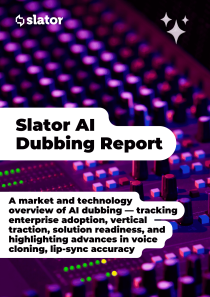
Slator 2025 AI Dubbing Report
The 85-page report analyzes the supply and demand for AI dubbing and the technical and operational nuances in delivering AI dubbing across verticals.
Language AI and Data-for-AI Enabler
Originally built for music and film studios, AudioShake’s technology now sits upstream of many language AI workflows. By isolating clean dialogue and removing background noise, it supplies better inputs for AI audio transcription, AI live captions, AI live translated captions, AI dubbing, AI subtitles, and AI live speech translation.
As showcased on the company’s website, its technology underpins localization use cases such as AI-Media’s real-time sports translation, where announcer speech is separated from crowd noise to generate live captions and multilingual synthetic-voice outputs; German film production studio Pandastorm’s dubbing of 1960s Doctor Who episodes, where separation enabled the clean replacement of English dialogue with new German tracks; and OOONA’s media localization platform integration, which lets users pre-clean audio before automatic speech recognition (ASR) for more accurate automatic captions.
Other examples include Hudson AI using AudioShake to extract clean dialogue for automated creator dubbing; Dubverse integrating the technology to improve AI dubbing and translation quality; and cielo24 leveraging separation for transcription, translation, and synthetic voice generation.
According to AudioShake, customers report 25% or greater improvements in transcription accuracy rates after separation — helping improve speed, quality, and cost efficiency across multilingual workflows.
AudioShake also positions itself as a data-for-AI enabler and provider. Developers can process large volumes of recorded material to produce structured datasets for training and fine-tuning speech and voice AI models.