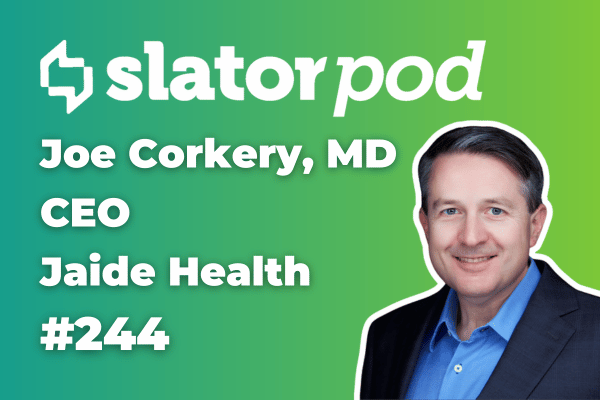
Joe Corkery, MD, CEO and Co-Founder of Jaide Health, joins SlatorPod to discuss how Jaide Health is driving medical interpreting and translation with AI, bridging communication gaps for limited English proficiency (LEP) patients and improving healthcare accessibility.
With a background in computer science, medicine, and AI product leadership at Google, Joe co-founded Jaide Health with Julie Wilner, RN, in 2023 to address a long-standing need for real-time, interactive communication for the LEP patient population.
Unlike older machine translation models, which worked sentence by sentence without context, Joe shares how generative AI can maintain coherence, track gender references, and infer meaning from prior context — crucial in medical settings.
Partner spotlight
Riding the AI shockwave
The future of AI adoption depends on trust, ethics and human expertise.
The CEO remains pragmatic about Trump’s executive order designating English as the US’s official language and revoking previous language access mandates. He argues that such policies will not change the healthcare industry’s commitment to multilingual patient care but may push hospitals to seek more cost-effective solutions — potentially accelerating AI adoption.
Looking ahead, Jaide Health is focusing on expanding into document translation, particularly for discharge instructions and patient portal messaging, areas where current solutions are slow or impractical.
Transcript
Florian: Welcome everyone to SlatorPod. Today on the podcast, another exciting startup company, and we welcome Joe Corkery. So, Joe is the CEO and co founder of Jaide Health, a tech company specializing in real time AI driven medical interpreting and translation services. Give us the Jaide Health elevator pitch. It’s quite early stage. You go to the website still, there is a wait list. So, give us the elevator pitch, to get started here.
Joe: At the highest level what we’re building here is basically a healthcare specific version of Google Translate. We want to make it easy for clinicians to interact with their limited English proficiency patients basically instantly by being able to have that conversation with them there, or as well to provide them with written translation of documents that they need to take home.
Florian: Tell us a bit more about your background. I think you were with Google, you were a product leader there? So, tell us about that. And you’re also a trained physician, so quite the combo.
Joe: I’ve been working at this intersection of healthcare and technology for the better part of 25 years now. I studied computer science as an undergrad at Princeton, and then I headed on to Harvard Medical School to get my MD. And interestingly, I took a two year hiatus in the middle of medical school to actually join a computational drug discovery startup. And I was working there as a software engineer for a couple years, which was a ton of fun and I really enjoyed that, but I decided I still wanted to go back and finish the degree because thought I might still want to practice day to day. So I went back, finished the degree. Ultimately, I decided I really wanted to do healthcare tech a little bit more from the tech side. So I ended up returning to that same company after graduation, stayed there for about another 10 years, which is what led me to Google. I had this really amazing opportunity to come join Google Cloud, because they wanted to really build out healthcare products on Google Cloud. And so I joined in 2014, and what I quickly discovered was that no healthcare organization was really willing to move to Google Cloud at that time. So I actually spent the next couple years really laying the foundations for healthcare customers, building out security, privacy compliance efforts, really making HIPAA compliance something you thought about first, as opposed to at the end. Eventually I, along with a number of others, convinced the Cloud leadership to start a sort of a dedicated new healthcare and life sciences vertical where I led the product team there. And, that’s actually where I met my co-founder, Julie Wilner. And we’ve been working together ever since, almost about eight years now. That was a really exciting time. We got to launch a number of new products really focused on healthcare data analytics, healthcare data interoperability, security, and of course AI, building out sort of healthcare specific natural language processing and healthcare specific speech-to-text. So did that really until about 2023, when Julie and I left Google, and we started Jaide later that year.
Florian: Was there a particular trigger for this? This probably was pre ChatGPT and pre just general AI? Just a few months probably before that.
Joe: It was definitely on the scene, increasingly on the scene around that time. We are technically clinicians, Julie’s a nurse by background as well. We knew that we were going to build something in healthcare space, and we wanted to build something that was going to have a meaningful impact on patients. As we were watching everything evolve, we really figured that generative AI was going to figure strongly into what we were doing, just watching that pace of evolution. And when you talked about sort of like a particular moment or challenge one of the things that we really spent a lot of time thinking about is back when we were both still at Google, we regularly heard requests from healthcare executives asking for Google to build a healthcare specific version of Google Translate that they could use with their patients. And this concept always resonated with me, partly because I remember enrolling in a medical Spanish class at Mass General Hospital so I could actually communicate with patients better. Of course, the limiting factor I had was I only had a foundation in Spanish, and there were a lot of other languages spoken. But for a variety of reasons, this really never gained traction at Google. We decided to see if there’s still interest in an offering like this. And the short answer was that yeah, there was a lot of interest. It was pretty widespread and I spent a lot of time talking with different CMIOs and CMOs across the industry here. And a lot of them actually highlighted this as a top priority for them to solve with a technological solution. And what I liked is that they trusted us as technically clinicians to actually build it. It wasn’t going to be just something we threw together. And so that interest combined with sort of their confidence and the applicability of large language models to this problem, and the ability for us to drive a positive impact on care delivery, kind of made it an obvious choice for us to invest in.
Florian: So I guess you can answer the question, “What if Google built this?” with some authority? Because that’s been the eternal question in the language industry for 10 years. So, what if Google did this? I guess in your case you’re like, “I was there, they didn’t build it, I built it now.”
Joe: The short answer is Google was really great at building the infrastructure, technology behind the scenes in this. And they do a lot of things great on the consumer side, but I think where there’s still a lot of opportunity is for startups and other organizations to really build the vertical specific applications on top of what they’re building. I think this is really something that I certainly learned during my time at Google, and elsewhere, that you really need a lot of deep domain expertise to sell into the healthcare industry, and you’re able to hire that. But ultimately it’s a different ROI than it is in other areas. And so it’s an area where I feel like they’re really excited to build a lot of the great AI technology that can be behind the scene, but really would rather partner or let others deliver the the actual vertically integrated application.
Florian: As a Harvard trained doctor, so let’s go a bit to the language element, patient-doctor communication. What are the different layers here, levels here, in terms of criticality, and what kind of obstacle is the language barrier? You mentioned Spanish, of course, number one language, and other than English, in the US but I mean there’s 100, 200 more that are spoken. So, what are some of the key aspects? And again, what kind of obstacle would the language barrier be in patient-doctor communication?
Joe: Communication is really at the heart of delivering healthcare. And when you’re trained as a doctor, you actually spend a lot of time learning how to talk to patients, learning how to do an interview, how to under elicit a history from them. So there’s a huge emphasis on communication. And a language barrier is very much a barrier. It gets in the way of being able to do that. And historically we’ve really relied on human interpreters to fill that gap, and they do a great job. But the challenge is there’s a lot of friction with getting an interpreter for your encounter. They’re a special, limited, rare resource. And so getting someone in the room with you at the right time there are a lot of scheduling challenges for that. There’s availability issues, what language you actually need. So it’s great when you can have that, but oftentimes you can’t, especially when you’re seeing someone quickly. And this is where I see one of the real great challenges. There are lots of situations in healthcare where your encounter is scheduled, you go in to see the doctor, they know when you’re coming. You have a surgery planned, you know when that’s gonna happen. But there are probably 10 times as many encounters that the healthcare provider has with the patient that are unscheduled. And what ends up happening is that limited patients who don’t speak English don’t get seen as often. They don’t have those encounters because of the friction in getting some somebody involved there. I actually saw a situation where a nurse had basically asked someone, “Can we kind of try to get through this in English? Because it’s so hard to get an interpreter on the line.” The patient clearly spoke enough English to be able to say yes to that, but I was also like, do they really understand the conversation that’s happening? Then when you look at inpatients, a huge part of your care is talking with your nurses. And those conversations are oftentimes very fast, very short, very targeted. But if you don’t have those, you can really end up feeling very isolated in the healthcare organization as a patient. I think ultimately communication is really central and I think there are really two things at play. How do you facilitate the scheduled interactions and then how do you facilitate those unscheduled interactions that happen sort of as a one-off? I think what we’re seeing is that patients who don’t speak English are getting way fewer of those unscheduled interactions than everybody else does.
Florian: Are you working at all with human interpreters? Or, are they somehow part of the platform? If so, how?
Joe: We’ve spent a lot of time talking with human interpreters, and this is a really passionate group of people who really want to provide care to a patient. But one of the things I’ve really seen is that they’re very excited to work on those complex human interactions. We’ve actually, I would say been really pleasantly surprised by the reception that we’ve seen from language services groups within hospitals, because they see us as providing another tool in their toolbox, where we can help them expand the reach of that organization so that their human interpreters can really focus on what they love to do, what they excel at. And we can tackle a lot of those other interactions where they’re not available. And so we like to think of it as we’re basically providing a tool that allows human interpreters to operate at the top of their license by taking on a lot of the work that they don’t want to do, or they don’t have the bandwidth to do.
Florian: Did the move from it used to be like neural machine translation, speech-to-speech was super hard to do at all, if even impossible given all the latency, and all these other problems? So, let’s say with ChatGPT October 2023, GenAI came on the scene. How do you view this for medical interpreting, let’s say, versus maybe any of the technologies before? Did you feel it’s only really possible to do what you do now with these technologies? Or could something like this have been reasonably done maybe three, four years ago, or it’s basically only possible now? Maybe just like one other thought. Everybody trusts these models a lot more than they used to. I mean, five years ago it’s like, “obviously machine translation is going to make mistakes.” Now people are putting all kinds of things into ChatGPT and expect a perfect answer. How do you mitigate the risks that still remain?
Slator Pro Guide: AI in Interpreting
The Slator Pro Guide: AI in Interpreting presents 10 new and impactful ways that AI is transforming the interpreting sector.
Joe: Clearly, people were using Google Translate to do this for years. Now, they weren’t supposed to, and it wasn’t providing the services they need, but it was filling a niche, and filling a gap. And so you could say that a solution like this built on technology from three, four years ago would have found a place in the market, if it had HIPAA compliance, and some optimization for the healthcare industry. But I think with generative AI, it really does change the way that all of this is possible. And one of the things that I think is really interesting that is that historically with neural machine translation, you would see most translations happen on a sentence by sentence basis, and they had no concept of context between the sentences. And when you look at something like generative AI, taking into context is really important. One of the things I think is interesting is if you have differences in gender, most likely you’re going to keep that in generative AI versus it might be kind of random in neural machine translations. Similarly, understanding that like, oh, “I talked about this thing three or four sentences ago, it still means the same thing here”, I think is really important. A good example of this where I think, well, one of the things I’m excited about generative AI is it allows you to provide a lot of context. Because one thing that we’ve seen in our work today is generating, translating discharge instructions, that information is often incomplete in terms of knowledge about the patient. You might see the term SSRI in there, and depending on the context, that could mean like “sliding scale regular insulin” or “selective serotonin reuptake inhibitor.” Those are very different things. And one of the things that’s nice about generative AI is you can provide more of that context, so it’ll have that. Also, we’re just seeing the pace of generative AI, the pace of improvement is so rapid that when you think about it, like the idea that you could actually use AI to do interpretation and translation in real time, three or four years ago, it’s like, no, that’s far, far away. But now you look at it, the pace it’s going, you’re like, oh, actually maybe two to three years from now, no one’s going to be questioning whether this is the right thing to do or the right approach. It’s like, oh, it’s there. And part of this is really building for the future. One thing I do want to touch on is speech-to-speech, because that’s actually really interesting to me. One of the challenges with speech-to-speech is you miss the ability to have a sanity check in the middle. And so a lot of what we do is, you speak, we transcribe that, we generate the translation, and also a back translation. And so you can actually see what you’ve said, how it’s been translated, how it thinks, what it thinks that means in real time. So that gives you the ability to correct, and you can see the same thing on the patient side. And I feel like that’s a really important sort of safety layer that exists in the middle right now, that like, maybe three years from now everybody will be like, “no this gets it right 99% of the time. I don’t need to worry about it.” But I think speech-to-speech is going to be huge outside of healthcare very early. But I think, it’s going ti take a little bit longer in healthcare because people are gonna wanna have more of those sanity checks.
Florian: We did speak about Google, and not going too vertically specific, but Microsoft released something called Dragon Copilot for healthcare, and they made a big kind of PR and marketing campaign around it. So did you look at this? How deep does it go? Like, is it competing in any shape?
Joe: It’s really interesting. I’m never a big fan of pre-announcements and we really try to only announce things when they’re ready to go, and have been deployed in multiple systems. But it’s a really exciting time for AI in health care, and Microsoft is very obviously making a big bet there. I’ve had a chance to kind of watch a couple of the videos and read some of the press releases there. And, it’s actually been hard to figure out a lot of details of its actual capabilities. But one thing I was struck by was they had this comment that says, “You can now conduct interviews in Spanish without the need for a translator.” And I’m like, well what does that mean? And it was really hard to find anything about what does that mean? But what I could glean is that basically at first glance, it sounds like they’re saying copilot can be your interpreter. But as I look deeper into the video, and some of the other details, I think what it’s doing, it’s not facilitating a multilingual conversation, but instead it’s supporting the generation of an English note, when both the physician and the patient are speaking Spanish to each other. And this is actually a pretty common scenario, in many areas in the US where there’s so many bilingual care providers that they’ll just have those interactions there and they’re both speaking Spanish. I’ll be curious to see, because when you watch their video, it’s like the interaction mode for this is capture Spanish. And I’m like, it didn’t say anything about it interacting with you. And I think, a lot of the the ambient AI technology out there those are tools that are designed to be in the background and they’re designed to not be present as part of the encounter. That’s where I think there’s a big difference between what we’re doing and what they’re doing. And that like we’re our goal is here to be in the middle of the encounter, as opposed to being in the background. I think there’s a lot of real, really exciting work going on, I do. I’m excited by the announcement because I think it represents a growing recognition of the importance AI is gonna have in the language services space, especially in healthcare. So, that’s great, but I also think there’s lots of room for multiple players as well.
Florian: Yeah, in the past they did a lot of announcements, “they” being just big tech, and then it just never quite went deep enough. And so, the ecosystem of kind of language tech providers is very, very lively. We have to talk about President Trump’s executive order, declaring English the only official language and revoking the Clinton era language access order. What are your thoughts on this?
SlatorCon London 2026
SlatorCon provides the platform for executives, founders, investors, and buyers to meet and get actionable market intel on what drives language tech, services, and AI.
Joe: Honestly, I can’t say I’m surprised by this executive order, but designating English as the only official language, or revoking that access order, I don’t think it’s going to fundamentally change the way healthcare is delivered in the United States. English has been the de facto official language for a long time. And just making that official doesn’t change the language diversity of the country. It’s not like healthcare providers are going to stop providing care to non-English-speaking patients just because they can’t speak English. Healthcare providers are going to do what it takes to provide them with with their needs. Ultimately politics change every four years, probably even more often. So our focus is to meet patients and clinicians where they are with the needs that they have today. I would say the one thing I do see this potentially changing though, is the pace at which healthcare organizations start to look for more affordable options to provide multilingual care. As the language access mandates are removed, and I think it’s a little unclear how much of that removal is actually there, I think it’s not gonna be enforced either way. And so I actually think that this actually represents an opportunity for AI to step up, and make an impact, as healthcare organizations tighten their belts, and move away from more expensive options, or at least limit those to where they have the highest need.
Florian: I mean executive orders aren’t laws. A lot of this is driven by other things than these designations and executive orders. So there’s probably in the short term, more of “vibe shift”. But yeah, another follow up on this, how do you see the general macro environment? Maybe just a little bit beyond even language access and language tech, I mean, there’s quite a challenging broader economic environment. But of course, AI, and AI technology, and AI language technology, like the one you’re building is probably about the hottest thing out there generally. So how do you balance these two things? Like you’re in an extremely hot space, super competitive course as well, but also kind of these macro headwinds, and uncertainties.
Joe: I think you’re absolutely right. AI is definitely extremely hot right now, especially AI and healthcare. I think the big challenge that everyone is facing is that it’s yet to prove out its ROI to the relevant stakeholders. I think there’s this rush to prove this out. I think that’s going to play out over the next two to three years, as people have a little bit more time to see the impact. And for us, that’s one of the reasons we’re really trying to heavily focus on making sure that we’re providing value, and measuring that value. Like for instance, I want to understand time saved in encounters, increases in patient satisfaction, reductions in cost, number of ER visits avoided, and the overall health outcomes. I certainly believe that this patient population is vastly underserved by the healthcare industry, due to the limited resources and high degree of friction. And bringing AI into the equation, I think we can dramatically expand the impact of healthcare workers leading to improved clinical outcomes and decreased care. I think a really interesting comparison to this is actually thinking about Uber. When you look at like what Uber did, where in terms of like getting a taxi it used to be you never really know how long you would have to wait until the next taxi was available. You’d stand on the corner in Manhattan and put your arm out and hope it wasn’t going to be out for 10 minutes. But with Uber it’s like, oh, I know exactly when this car is going to arrive. And that really changed the way people think about booking and planning, but it also really changed the way people thought about driving and getting around. And you find yourself seeing that people are renting cars less, you’re seeing fewer drunk driving accidents because people are like, “oh well, like I don’t need to drive to this. I can take an Uber that’s easy to do.” I think it really changed the way people think about how they interact with cars and transportation. I see sort of this corollary here with bringing AI into the world. It’s gonna transform the way people use language services in ways that we don’t expect. I think we’re going to see this explosion in the use of language services in the way we saw this explosion of ride sharing because it’s easy, and it’s available.
Florian: I totally agree. I think people have barely wrapped their head around what it means if this is actually going to start working for real. Because there have been so many false starts, in the past 10 years, and so many apps that promised but didn’t deliver. Yeah, I think now we’re at the cusp of this actually working and us being able, for example, to have an actual call here that’s live speech-to-speech translated. Yeah, will be super exciting. So, in 2024, last year you raised a two and a half million dollar seed round. Like any plans to follow up on that? What are your plans there for product-led growth versus maybe starting to spend a little bit on marketing, and sales?
Joe: I would say like right now we’re really heads down with a lean and very efficient team of experts trying to ensure that our early hospital customers are having a great experience, and we’re learning and improving from those engagements. We see ourselves as like really a first mover in the space with the right team, without any legacy or tech product overhead, which means we’re able to move quickly and are already live in hospital systems today. But ultimately like I’m a physician and engineer and so like, I think we’re always going to be product-led, and we’re going to be going to build the best product that we can. The early versions that we’ve built are resonating, and we’re actually seeing a lot of continued inbound interest with new executive engagements every week. I think leading with the product here for us has been really valuable. And I would say, one thing that we’ve been surprised by is that everybody typically everybody in the industry typically knows that healthcare sales cycles take a long time. But that hasn’t been our experience to date. We’ve seen hospitals wanting to move quickly on this and and getting it into their hands. And so with that in mind we’re going to continue to focus on those organizations that want to be early adopters, and launch as much technology as we can in the short term.
2024 Slator Pro Guide: Translation AI
The 2024 Slator Pro Guide presents 20 new and impactful ways that LLMs can be used to enhance translation workflows.
Florian: Great. What’s on the roadmap for 2025? We probably shouldn’t go beyond that.
Joe: There are a couple of things. I think one of the things that we’re really focusing on a lot in 2025 is document translation. It’s an area where we’re seeing a ton of interest in hospitals. And I think historically patients are sent home without instructions in their own language. They’re not getting personalized instructions, they’re getting sort of formulaic handouts. I mean, at the end of the encounter they might have someone explain to them what’s going on. You have this concept of the visual interpretation where they’ll read, and explain it to you, but at the end you still don’t have anything written in your own language. And the challenge was like translating a discharge instruction could take anywhere between 30 minutes to a couple hours. And so it’s just not practical to have it done in-house. And it’s definitely not practical to have it done outsourced when you look at turnaround times of days on some of those things. So one of the, so we’ve really, we’ve been focusing a lot on how can we help facilitate expanding communications in written form, in addition to spoken form? And so, after-visit summaries is an area where we’re seeing a lot of activity. We actually have deployed this now at Children’s Hospital of Los Angeles. And it’s been really exciting to see that they’ve been using this to translate after-visit summaries, for that. And because the goal there is really like at that point of discharge you can have that information with you to go home so you actually understand it. And we think that’ll actually be transformative, in terms of both improving adherence to treatment, as well as reducing the likelihood of readmission or ER visits for clarity. Similarly, where we’re seeing another avenue where we’re seeing a lot of this is with patient portal messaging. The use of patient portals has grown very rapidly over the past few years in the United States, but this community has been left out of that growth. Actually, it was funny, I’ve talked to a couple hospitals. They say, “We’re actually encouraging patients to communicate with us in their own language through patient portal, but we don’t have any way of dealing with that.” And so, they’re kind of like they’re trying to get users engaged in the hopes that in the future that they’ll have a plan for how to do this. And so, anyway, it’s kind of this really weird space. I would say this patient population doesn’t have a way to communicate asynchronously with their care providers. And so, being able to bring translation to portal patient messaging means that one of the big things we’ll see there is sort of the decrease in the unnecessary utilization of emergency departments. Where it’s like, you have a question, you need it answered, you don’t want to have to go in for an office visit, you’d rather not go to the ER and you can send the message and depending on the latency at the hospital, the turnaround time, you could actually get an answer back in time where it would actually change what your course of action will be.
Florian: How challenging is it to do both, like the speech element and the text element? Because typically the industry, it thinks of this as very separate things. Different companies, different industries. They barely meet. There’s the interpreting world, and the translation world. They each have their own set of challenges and you’re bringing them together under the healthcare and hospital roof. Generally, do you see any major difference in terms of how challenging both are? Or you can just see them as both part of the same problem, essentially?
Joe: They share a common foundation, but they are two very different use cases. As you build the product, we’re really building two different products, an interpreter and a translator. They have a different user experience, they have different ways that we go about testing them, and validating them, with organizations, and frankly even like the form that you’re gonna use them in, like the interpreter is really designed to be sort of a mobile-first encounter where it’s running on an iPhone or an iPad. I think iPads are actually where we’re gonna see the most traction. Whereas for the translator, people are doing it at a desktop. I think oftentimes the users are different too. On the interpretation side, the users are gonna be physicians, nurses, front desk staff, PT, OT, care providers. But it’s actually at the same time just people in the hospital where this is going to really facilitate check-in, and scheduling. There are a whole bunch of administrative workflows that we didn’t really even talk about that I think are going to really be expanded here as well. Then on the translation side, one of the things that we’re actually seeing, in terms of the users, it’s front desk staff potentially just translating something at discharge. But an area where we’re seeing a lot of excitement is actually use of the translator by the human interpreters, as a way for them to support the generation of the translation of a summary at the end of the encounter. Because right now, an interpreter might facilitate an engagement. Then they’re like, “Oh, could you translate this note afterwards?” and they’re like, “No, I have to run to this other employment” or “it’s gonna take me two to three hours and, to do that.” What ends up happening is a lot of hospitals either just don’t do that or they have people on the interpretation staff who are sort of assigned to do translations on a daily basis as as part of their shift. But those take a really long time. And so the ability to generate a translation of a document for them, which they can then scan, review and sign off on, and this is especially after a long inpatient discharge, it’s like 20 pages of documentation, gives them the ability to do that. That’s an area where we’ve seen a lot of excitement and interest. But you’re right, there are different products, they use a lot of the same technology under the hood. But ultimately, and I think this gets back to like, everything in healthcare is like, it’s workflow is what kills technology. And how do you integrate into the existing work systems? And it’s like the AI itself is not the differentiator in most of these, or in healthcare technology, it’s how do you fit into their workflows? How do you how do you make it easy for them to do their jobs? Because honestly, clinicians hate change. And changing the workflow is one of the biggest challenges in getting adoption for people. So making it easy, making it fit into their system is really critical.
Florian: I think that’s where your background is invaluable because the traditional kind of language service provider, CEO or language tech founder wouldn’t understand the nitty gritty, wouldn’t understand the workflow, so wouldn’t even know what to build for, right?
Joe: Exactly. This is why I love working with my co-founder, Julie that as a nurse by background, nursing runs all the workflow in hospital and she deeply understands that, and regularly reminds me. She’s like, “Physicians often have a great experience with this because the nurses all set it up in the background.” So really thinking about how do we empower and enable nurses is key, but I think you kind of touched on this interesting point of like we’re certainly seeing a lot of people pop up in the space. Like, whether they’re Y Combinator startups, or like Stanford grads at a hackathon over the weekend, just building something and while it’s easy to throw something together that does this, there are a lot of things that you have to do to actually make it work in healthcare. I would say, there are a lot of wrong ways to build in healthcare. And but like, when you think about, it’s like HIPAA compliance, SOC2 compliance those are table stakes. Those are things that you don’t just throw on at the end. You have to build from the beginning. I think that’s having worked in this space, really understanding that there’s this need for a secure foundation from the beginning. So thinking about privacy, security, compliance, and trust as you build from the beginning, is critical. I think the point there being, like we like to think of ourselves sort of like techie clinicians who really deeply understand both the workflows as well as the tech. How do you actually build technology for the space?
Featured
Partner spotlight
Boost Language Access
Improve health outcomes and ensure compliance for individuals with LEP