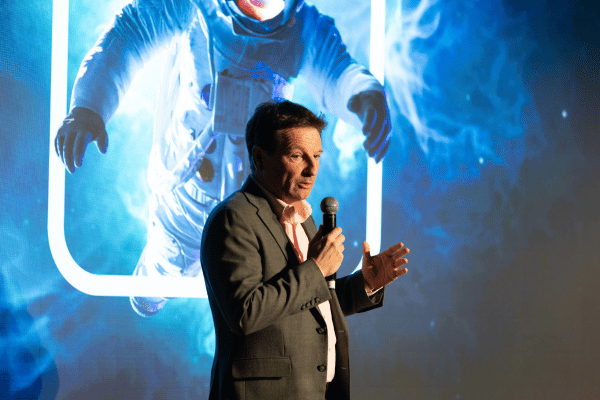
“If our companies were characterized by movie titles, which movie would they be?” Bertrand Gstalder, CEO at Acolad asked this question at a recent Acolad partner event and shared one answer at SlatorCon London 2025: “Everything Everywhere All At Once. And it’s not surprising,” he added. “Disruption is not on the horizon, it’s already here. And it’s the pace of disruption we need to manage.”
Gstalder compared this disruption with that of the music industry in the 2000s: “suddenly physical music was quickly replaced by almost free digital music. First with piracy, and then with new streaming subscription models. While this transition initially brought about a massive drop in the market value, today this market value is even higher.”
Gstalder believes parallels can be drawn to the localization industry: “Let’s be optimistic and consider this is a necessary yet intense transition phase. The temptation to remove humans in the translation process is real, but let’s remember, AI keeps learning but can’t feel. Human feeling is key.”
Partner spotlight
Riding the AI shockwave
The future of AI adoption depends on trust, ethics and human expertise.
“What I’m finding as a trend is that human stories are becoming more important than ever because no AI tool can tell an authentic story of a lived experience. It can of course come up with fake examples, but nothing will tell a story like a human can, who has been through an experience and can identify the emotions that they felt.”
“What I love is that this is going to help make a lot of our content more human-centric and a lot more real,” he added.
Agility, Efficiency, and Trust
The CEO reflected on how Acolad’s 30th anniversary came at a pivotal moment for the company, one of “revolution and renewal” where the way content is delivered is “new and exciting” for the localization industry.
“We are embracing three imperatives: agility, efficiency, and trust. First, we need to be agile. AI is moving fast, with new models, new capabilities, new risks almost every week. That’s why being tech-agnostic and open has always been part of Acolad’s DNA, and part of our agility. No one can build everything alone.”
“We develop proprietary capabilities where it makes sense, where it gives us an edge, but more often success is about smart integration. It’s about building adaptable architectures that can evolve as fast as technology is evolving,” he added.
“Secondly, we need to be efficient. Process matters more than ever. This is where technology becomes a competitive edge. Smaller, less efficient players may struggle in the long run. We are constantly pushing for automation, scalability, and quality, not just in operations, but across the business. We are constantly rethinking our operating model.”
As for Acolad’s third focal point, Gstalder said, “we need to build trust because when everything changes — your workflows, your vendors, your tools — what remains is trust in the context of AI and automation. Trust is not just about believing in the technology, it is about having reliable frameworks that make our clients feel safe. That includes data security, ensuring every interaction and every asset is protected and AI usage is transparent.”
Responding to Buyer Needs
The Super Agency CEO referenced insights from the Slator 2025 Localization Buyer Survey: “The report states that buyers are struggling with AI adoption, but not because the tools do not exist, but because they do not know who to trust with the implementation. Over half of them say they want their LSI to guide them, to not just offer services, but to provide strategic advice and hands-on support with AI.”
“That’s why we have invested in building cross-functional teams that combine linguistic expertise, solution design, and tech leadership. More than ever, the frontiers between tech, product, and linguists are narrowing because trust isn’t a side benefit, it’s the foundation for long-term innovation,” he added.
Gstalder cautioned that while localization buyers want to be guided by their LSI, they should also engage in “stronger partnerships” and away from a “commodity, multi-vendor approach that tends to thrive in our industry.”
“Those who embrace deep strategic partnerships, not commoditization, will be the ones who innovate in the long term, adapt, grow, and get the long-term benefit of efficiency and quality.”
“Once again, to quote Slator’s Buyer Survey, nearly 40% of enterprise buyers see insufficient use of AI and automation as their number one cost inefficiency. That’s telling. They want better workflows, clearer strategies, and fewer manual processes, not just cheaper rates,” he added.
“We help clients move beyond fragmented vendor models that create those inefficiencies and slow down time to market. We co-design solutions and — crucially — we bring proactive AI guidance. We believe that clients who let us challenge legacy processes and who are open to transformation are the ones that will benefit the most from the new possibilities.”
Gstalder concluded: “The companies that blend human creativity with AI-driven intelligence without fear, that lead with care, stay open, are agnostic, agile, and committed to continuous learning, are the companies that will probably define the future. At Acolad, that’s the path we try to embrace.”
Featured
Partner spotlight
Boost Language Access
Improve health outcomes and ensure compliance for individuals with LEP